Are you struggling to achieve color cohesion or harmony in your wardrobe or home?
Perhaps you own a closet full of clothing, yet only a few pieces match one another or truly flatter your appearance. Or, the decor in your home seems dull or lackluster, and you have difficulty creating a sanctuary that you find appealing and enjoyable.
If the above sounds familiar, the inaccurate colors are being chosen.
Color analysis quizzes were created to bolster individuals with their color selections. By undergoing the accurate color analysis quiz, you acquire the information that you need to make informed and skillful color decisions.
In this Blog Post, we explain what you can learn from the various color analysis quizzes and questionnaires.
How Does A Color Analysis Quiz Work?
Color analysis quizzes are designed to uncover a specific category of colors that best complement you.
Many color tests are available online for free. Seasonal color evaluations are the most widely appropriated type of color assessment tool.
Types Of Color Analysis
Below are two common types of color analysis methods:
- Online Color Analysis: Typically Quizzes or Questionnaires
- Personal Color Analysis Consultation: Generally In Person Meeting or Digital Communication
Online Color Analysis Quiz
An online color analysis quiz customarily consists of a few brief questions concerning your external features. Routinely, you are instructed to select your hair color, eye color, and complexion color.
You may also be asked to provide the colors of clothing that you think appear best on you and the eye shadow and lipstick colors that you prefer.
After answering the questions, information is offered regarding color type or season. You may then receive suggested colors in the form of a palette.
An online search for “Color Analysis Quiz” will yield the following outcomes:
- C Color® Quiz: The C Color Methodology is the only DNA foundation color analysis system. The C Color Quiz will authenticate your C Color Spectrum®. A C Color Spectrum is a category of a myriad of colors classified by temperature, saturation, and the predominant base of a primary color of either Blue, Yellow, or Red.
C Color Teaches You To Look Inside For Color

- Seasonal Color Analysis Quiz by The Laurie Loo: This questionnaire makes inquiries regarding favored makeup colors, favored jewelry metal colors, hair, eye, and skin tone colors.
- What Is Your Seasonal Color Palette by 30-Something Urban Girl: This questionnaire makes inquiries, regarding hair colors, eye colors, and complexion colors and instructs you to select a dress color and lipstick color that you believe flatters you.
- 4 Season Color Analysis by Color Me Pretty: This seasonal color analysis guides you through the 4 Season Color Analysis, which relies on hair colors, eye colors, and skin colors, stemming from Carole Jackson’s “Color Me Beautiful” business.
When exploring color analysis quizzes, it is important to understand that most, if not all, questionnaires adhere to the seasonal color assessment and do not take into account your inherent color proclivities, as per the C Color® Ideology. Rather, these quizzes and methods pose questions about external features, favorite trends, or celebrity comparisons that do not align with your immanently preferred colors.
Ultimately, you will receive conflicting developments from each quiz, further complicating the color resolution making process.
Personal Color Analysis Consultations
During a personal color analysis consultation, a color consultant will evaluate your external features for a type or season. Then the consultant may drape you in various fabrics to establish the colors that they deem the most compatible with your external features.
Following the consultation, you will most likely receive suggested colors in the form of a palette.
Similar to seasonal color quizzes, a personal color analysis consultation is entirely dependent on external features: hair colors, eye colors, and complexion colors. As a result, your outcome will be confusing, unreliable, and inaccurate, as the system is neither logical nor linear.
There has been no innovation since the externally implied seasonal color analysis theory and scheme were popularized in the 1970s, with the exception of the C Color® Ideology and Methodology.
The C Color® Quiz and color matching technology are accurate as the protocols are predicated upon intuitive inclinations.
There Are Only Two Color Analysis Theories:
- Internal Based Ideology: Criteria/DNA, Color Intelligence
- External Features Theory: Criteria/Hair, Eye, Complexion Colors
External features such as hair, eye, or complexion colors are irrelevant because these features contain numerous colors. It is not possible to distill a myriad of colors into only one hue.
What You Can Learn From A Color® Analysis Quiz
Color analysis consequences can be life changing; therefore, discovering an accurate color analysis method is paramount.
Keep in mind that dozens of color analysis methods exist, and again, most, if not all, employ the seasonal color analysis method.
Subsequently, one analysis may deem you as a soft autumn, while another classifies you as a warm spring. These conflicting conclusions and palettes of inconsistent colors add unnecessary confusion to the matter and hinder your ability to choose colors. As mentioned above, the external features of hair, eyes, and complexion colors each consist of multiple colors that can be changed and change over time.
Due to the evidence that numerous colors are found in external physical features, it is impossible to externally qualify the colors that an individual should wear and surround themselves with daily.
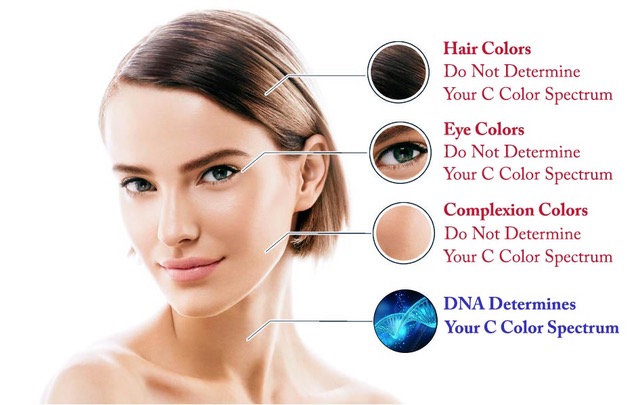
Reducing your colors to one season or type is not rational, and quantifying one group of colors to a season is not feasible. What exactly is a “winter color” or a “spring color”? Each season encompasses thousands of colors that appear dissimilar in different parts of the world, and people’s perceptions of seasonal colors vary.
You will also learn that people often confuse the temperatures, saturations, and predominant bases of colors. Color analysts, makeup artists, stylists, designers, and most other industry professionals categorize blues, greens, and purples as cool colors and reds, yellows, and oranges as warm colors; nevertheless, all colors can be cool or warm.
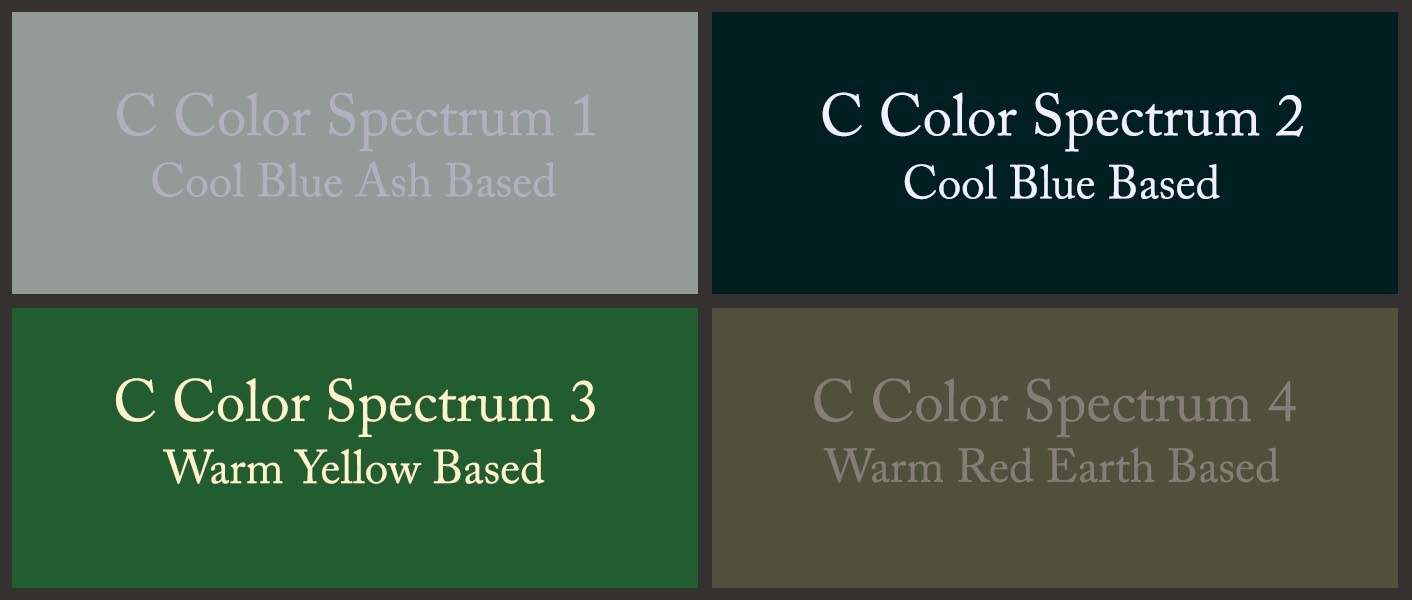
The above color quadrant displays a Cool Blue Ash Based green color, a Cool Blue Based green color, a Warm Yellow Based green color, and a Warm Red Earth Based green color, as examples to further distinguish the four C Color Spectrums. Each C Color Spectrum® contains millions of every color.
By taking the accurate color analysis quiz, you will receive worthwhile aftereffects that are advantageous in enhancing your appearance and the representation of your surroundings.
Obtain Accurate Results With The C Color Quiz
C Color® is the first and only company to quantify intuitive color preferences. Quantifying intuitive color inclinations is the specialty of our lifestyle technology company.
The C Color Ideology and Methodology will support you in living life in your auspicious color environment.
As stated, the C Color® Ideology and Methodology are predicated upon a color gene within your DNA. Unlike seasonal color analyses, exterior features are not considered, as exterior features do not aid in determining your genetic color partialities.
You are born with native propensities toward colors; consequently, you embody the virtue of color intelligence.
The CEO of C Color® developed a proprietary system for categorizing all 16.7 million known hex codes or colors in the world by identifying the temperature, saturation, and predominant base of the colors, which are one of the primary colors of either blue, yellow, or red.
C Color® has a comprehensive database consisting of millions of colors that are within the four proprietary C Color Spectrums®.
To determine your C Color Spectrum, take the less than five-minute, simple, and effective C Color Quiz. The objective of the C Color Quiz is to select the color quadrant that immediately catches your eye. In doing so, you are following your ingrained color dispositions. Thinking about your color choices will skew the aftereffects.
The accurate results of the C Color Quiz champion intuitive elections, not thought choices.
Due to this reason, receiving a Personal C Color Analysis differs from all others on the market.
The efficacy of the C Color Quiz is 99.8%. We do not guarantee hundred percent efficacy, as clients may not consistently follow their innate preferences or intuition throughout the C Color Quiz.
Below is the first example of how individuals from each of the four C Color Spectrums can wear green colors.
Please note that clothing and accessory colors are for reference only and do not represent the models’ C Color Spectrums.
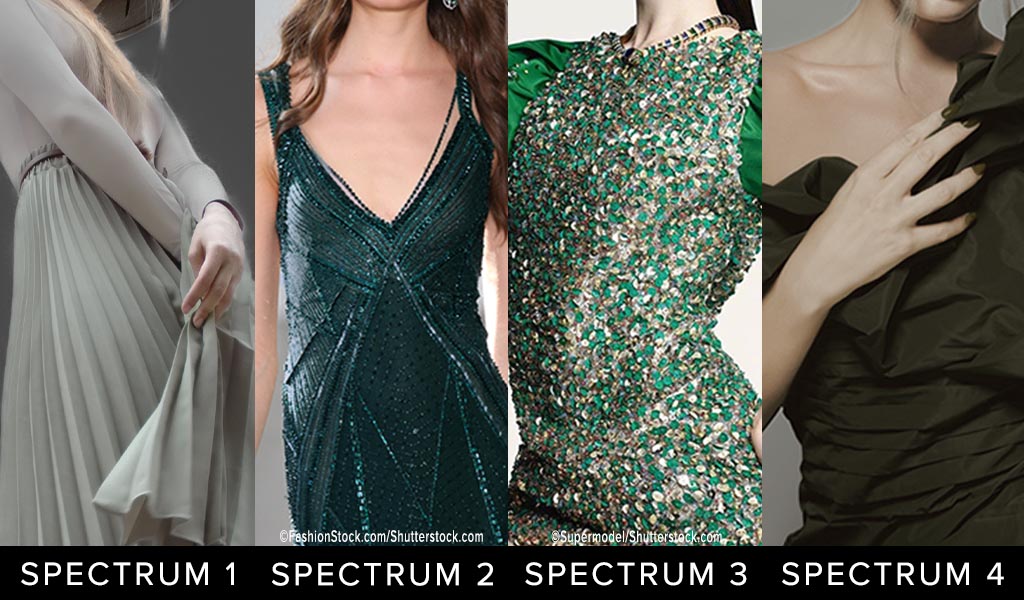
Notice the differences in the four C Color Spectrums:
- C Color Spectrum 1 Light Green is Cool Blue Based, Less Saturated, Appears Rubbed with Ash
- C Color Spectrum 2 Green is Cool Blue Based, More Saturated
- C Color Spectrum 3 Green is Warm Yellow Based, Moderately Saturated
- C Color Spectrum 4 Green is Warm Red Based, Less Saturated, Appears Rubbed with Earth
The key to the classification of all colors is the temperature, saturation, and predominant base of one of the primary colors of blue, yellow, or red.
C Color offers an innovative Methodology to navigate color and directs you in choosing the incomparable colors for everything in your world.
Please be sure to visit the C Color Website.
The refreshed C Color Website includes a plethora of engaging content, simple navigability, and instructive visuals representative of each C Color Spectrum.
Browse the C Color Website and C Color Blog Posts for a colorful experience and inspiration regarding all things color.
Below is the second example of how individuals from each of the four C Color Spectrums can wear green colors.
Please note that clothing and accessory colors are for reference only and do not represent the models’ C Color Spectrums.
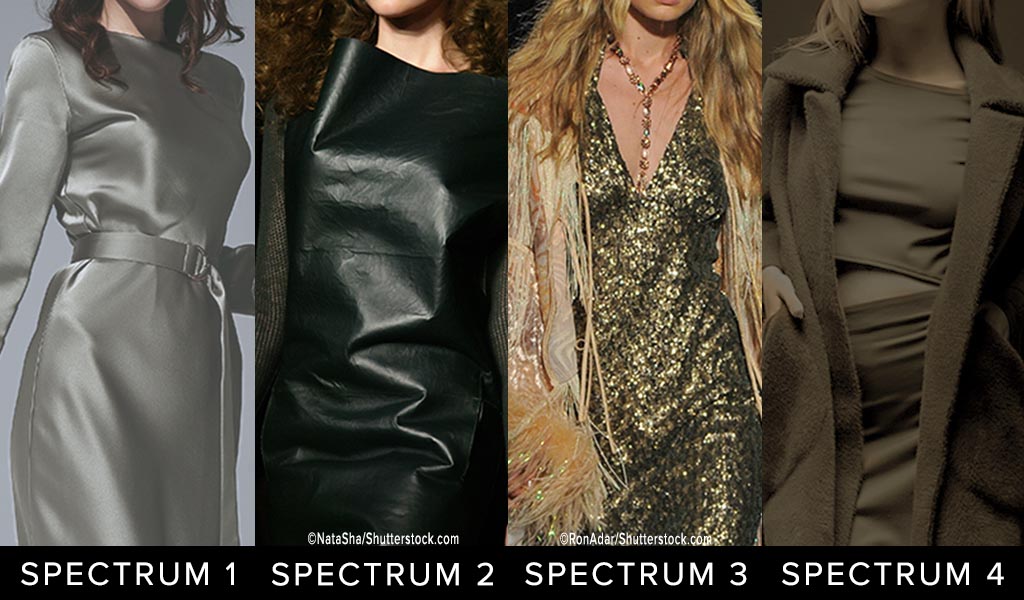
Notice the differences in the four C Color Spectrums:
- C Color Spectrum 1 Light Green is Cool Blue Based, Less Saturated, Appears Rubbed with Ash
- C Color Spectrum 2 Green is Cool Blue Based, More Saturated
- C Color Spectrum 3 Green and Tan are Warm Yellow Based, Moderately Saturated
- C Color Spectrum 4 Green, Tan, and Gray are Warm Red Based, Less Saturated, Appear Rubbed with Earth
The key to the classification of all colors is the temperature, saturation, and predominant base of one of the primary colors of blue, yellow, or red.
One of the numerous rewards is that the clothes in your wardrobe will intermix effortlessly, creating unfathomable convenience.
The privileges derived from wearing and utilizing the colors within your C Color Spectrum® are vast.
Look, Think, Feel, Act, Learn, and Heal your best with C Color.
Primed to discover your natural propensity for colors?
C Color® conquers the color conundrum and teaches you to implement color to successfully portray your true essence!
Look and feel prettier or more handsome; experience glowing skin; receive compliments; gain confidence; and garner color confidence.
C Color Gets You There!
Remember: Hair, Eye, and Skin Colors Don’t Matter
“Think colour! Know how to imagine it.” …Gustave Moreau, Artist
©2026 C Color, LLC. All Rights Reserved.
Socialize With Us