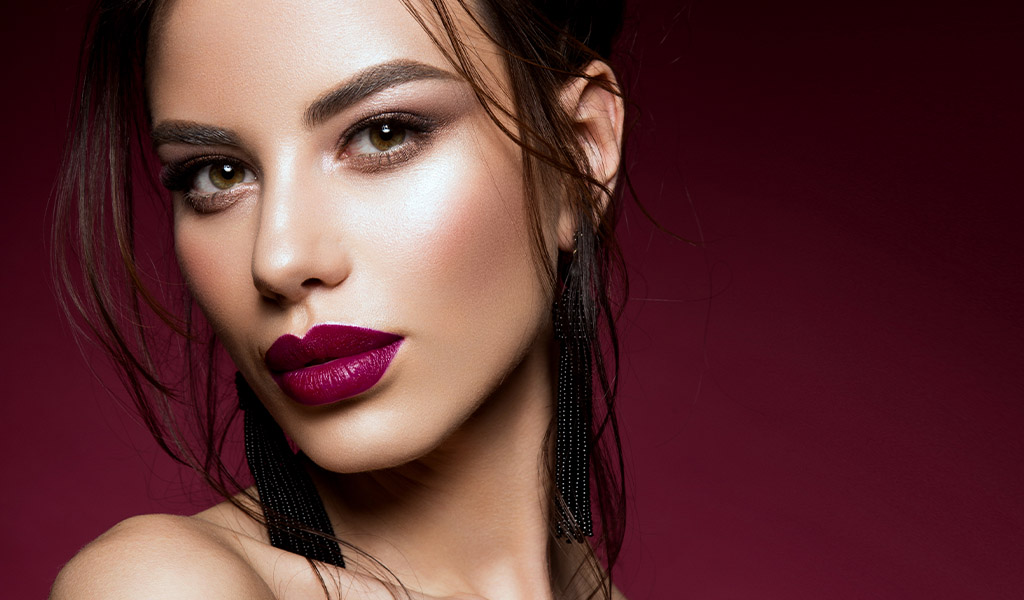
Color selection is a necessity of life. This commonplace practice can be purposeful and productive when an understanding of the power of color is embraced. Since individuals are required to make color judgments on a daily basis it is nice to know that assistance is available and that the endeavor can be enjoyable.
The Benefits Of Color
The benefits of color have spawned entire industries designed to support people with color selections regarding fashion, décor, design, and all else.
Are you aware of the colors that give your complexion a glowing and flawless aspect and draw others toward you?
Adhering to color trends or following the color advice of family or friends is an ineffective means of selecting colors to wear, surround yourself with, or apply throughout your life.
How do you discover the colors that are exemplary for you?
There are many widely appropriated color analysis methods, such as the seasonal or element color analyses, which are both discussed in this Blog Post, although these methods are neither linear nor logical and thereby impossible to follow.
There has been no innovation since the externally implied seasonal color analysis theory and scheme were popularized in the 1970s, with the exception of the C Color Ideology and Methodology.
C Color Teaches You To Look Inside For Color
There Are Only Two Color Analysis Theories:
- Internal Based Ideology: Criteria/DNA, Color Intelligence
- External Features Theory: Criteria/Hair, Eye, Complexion Colors
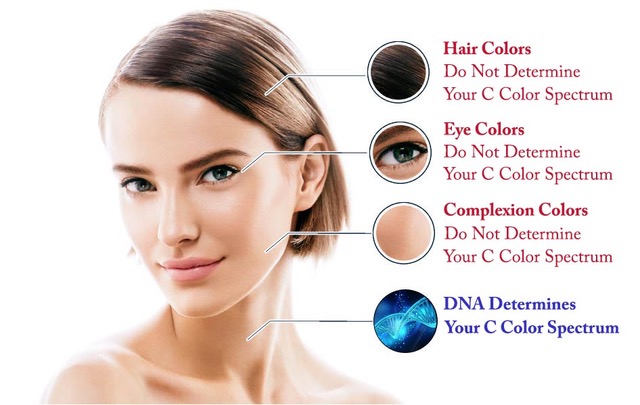
External features such as hair, eye, or complexion colors are irrelevant because these features contain numerous colors. It is not possible to distill a myriad of colors into only one hue.
Ultimately, the C Color® Methodology is the most accurate way to discover and take advantage of your superlative colors.
Below are examples of how individuals from each of the four C Color Spectrums can wear silver/black, burgundy/navy, grape/gold, and green/gunmetal colors.
Please note that clothing and accessory colors are for reference only and do not represent the models' C Color Spectrums.
Notice the differences in the four C Color Spectrums:
- C Color Spectrum 1 Silver and Black Pattern is Cool Blue Based, Less Saturated, Appears Rubbed with Ash
- C Color Spectrum 2 Burgundy and Blues are Cool Blue Based, More Saturated
- C Color Spectrum 3 Grape and Gold Pattern is Warm Yellow Based, Moderately Saturated
- C Color Spectrum 4 Green and Gunmetal are Warm Red Based, Less Saturated, Appear Rubbed with Earth
The key to the classification of all colors is the temperature, saturation, and predominant base of one of the primary colors of blue, yellow, or red.
What Is A Color Analysis?
A personal color analysis is designed to distinguish the colors that complement you.
Once your colors are identified through a proper color analysis, color resolution can become relatively effortless. The accurate color approach can beautify your wardrobe, home, office, and life in general.
As mentioned above, for the most part, there are only two color analysis theories: the internal DNA implied Ideology and the external features supposition.
Below, the two philosophies are compared for your discernment.
Color Analysis Methods
The first internal DNA color analysis method listed below, ascertains the genetically preferred colors of individuals.
The remaining three external color analysis methods listed below resort to hair, eye, and complexion colors as the determining criteria.
The Color Analysis Methods:
- Internally DNA Implied Color Analysis
- The 4 Season Color Analysis
- The 12 Season Color Analysis
- Element Color Analysis
Internally DNA Implied Color Analysis

C Color® is the first and only company to quantify intuitive color preferences. Quantifying intuitive color inclinations is the specialty of our lifestyle technology company.
The C Color Ideology and C Color Methodology will sustain you in living life in your consummate color environment.
The C Color Ideology and Methodology are predicated upon a color gene within your DNA. You are born with ingrained proclivities toward color; consequently, you embody the virtue of color intelligence.
C Color® does not take external features, such as hair, eye, or complexion colors, into consideration, as those features are inconsequential when determining your intrinsic color partialities. Accordingly, these features contain a myriad of colors, so it is impossible to distill them to only one hue.
Color Temperature Clarification:
Color analysts, makeup artists, stylists, designers, and most other industry professionals categorize blues, greens, and purples as cool colors and reds, yellows, and oranges as warm colors; nevertheless, all colors can be cool or warm.
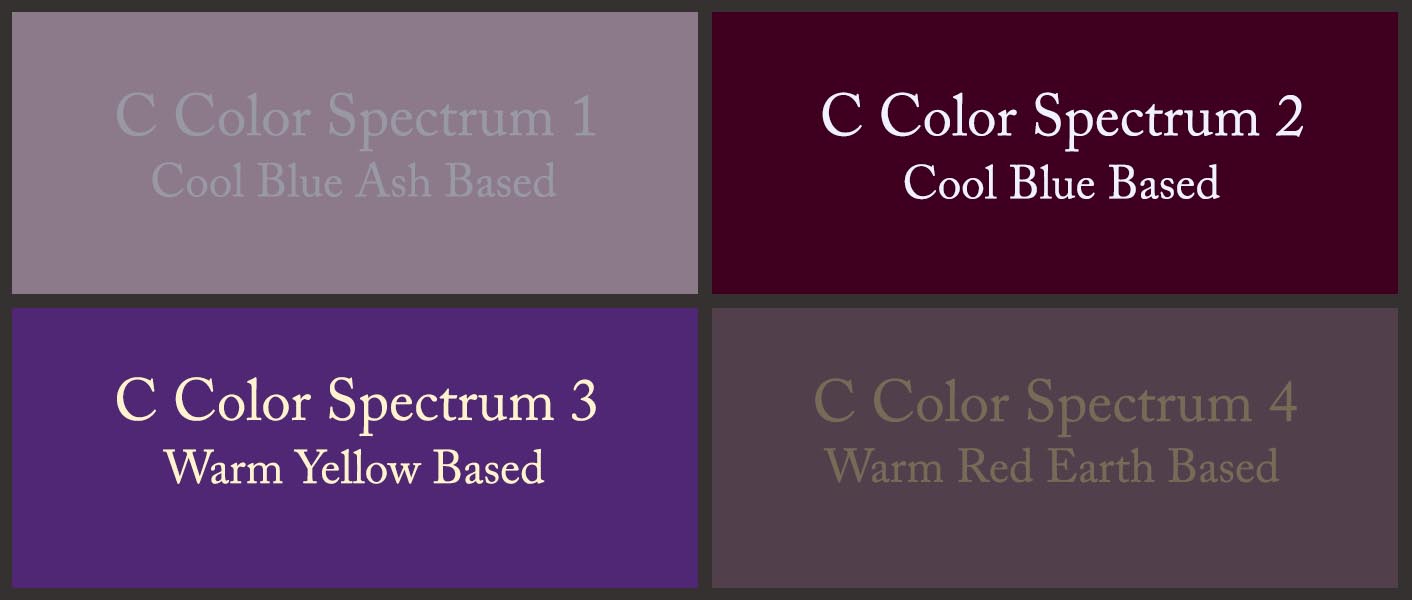
The above color quadrant displays a Cool Blue Ash Based purple color, a Cool Blue Based burgundy color, a Warm Yellow Based purple color, and a Warm Red Earth Based purple color, as examples to further distinguish the four C Color Spectrums. Each C Color Spectrum® contains millions of every color.
4 Season Color Analysis
The 4 Season Color Tonal Analysis deems whether you are a "Warm Type," founded on warm yellow cosmetic foundation, or a "Cool Type," founded on cool pink cosmetic foundation. Gold and silver fabrics are also draped against your skin to determine which color appears to blend more favorably with your complexion.
Your skin undertone is assessed to determine whether you are a "Light Type" or a "Dark Type." Warm undertones equate to either Autumn: dark eyes, dark hair, or Spring: light eyes, light hair. Cool undertones equate to either Winter: dark eyes, dark hair, or Summer: light eyes, light hair.
12 Season Color Analysis
The 12 Season Color Flow Analysis seeks to affirm your dominant characteristic or most notable external feature and secondary characteristic, meaning the shades that appear the best on you, and then places you into one of the following groups: Deep, Light, Warm, Cool, Clear, Muted.
Hinging on these combinations, you are assigned to one of 12 seasonal colors:
- Autumn: deep, soft, warm
- Spring: light, clear, warm
- Winter: deep, clear, cool
- Summer: light, soft, cool
The 12 Season Color Analysis system has more categories than the 4 Season Color Analysis system; however, due to the fact that the seasonal analysis determinants are largely subjective, consequences can vary with both approaches.
The Element Color Analysis
An Element Color Analysis derives your colors from the elements of Nature: wind, water, earth, and fire. The system makes use of external features to presuppose your element, which can consist of a single element or a mixture of two elements. The 16 available palettes express the essence of one or more of the elements of nature.
Opponents of this method point to the reality that elements appear different in places throughout the world, similar to seasons; thereupon, the aftereffects vary as the determinants are subjective.
Conduct Your Own Color Analysis With C Color®
The C Color Methodology is simple and intuitive. Take the 5-minute C Color Quiz, and receive your C Color Spectrum.
A C Color Spectrum® is a category of a myriad of colors classified by temperature, saturation, and the predominant base of a primary color of either Blue, Yellow, or Red.
The reward is the determination of your inherent color predispositions.
The objective of the C Color Quiz is to select the color quadrant that immediately catches your eye. In doing so, you are following your latent color predilections; therefore, the accurate developments of the C Color Quiz are sanctioned on intuitive choices, not thought choices. Thinking about your color selections will skew your results.
Due to this reason, receiving a Personal C Color Analysis differs from all others on the market.
The efficacy of the C Color Quiz is 99.8%. The company does not guarantee hundred percent efficacy, as clients may not consistently follow their innate preferences or intuition throughout the C Color Quiz.
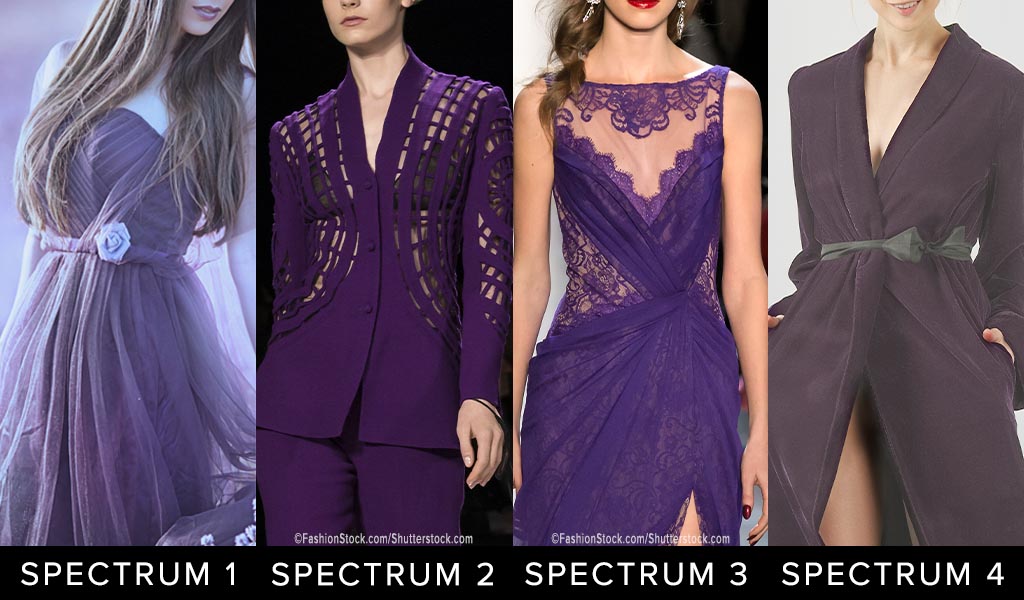
Below are examples of how individuals from each of the four C Color Spectrums can wear purple colors.
Please note that clothing and accessory colors are for reference only and do not represent the models' C Color Spectrums.
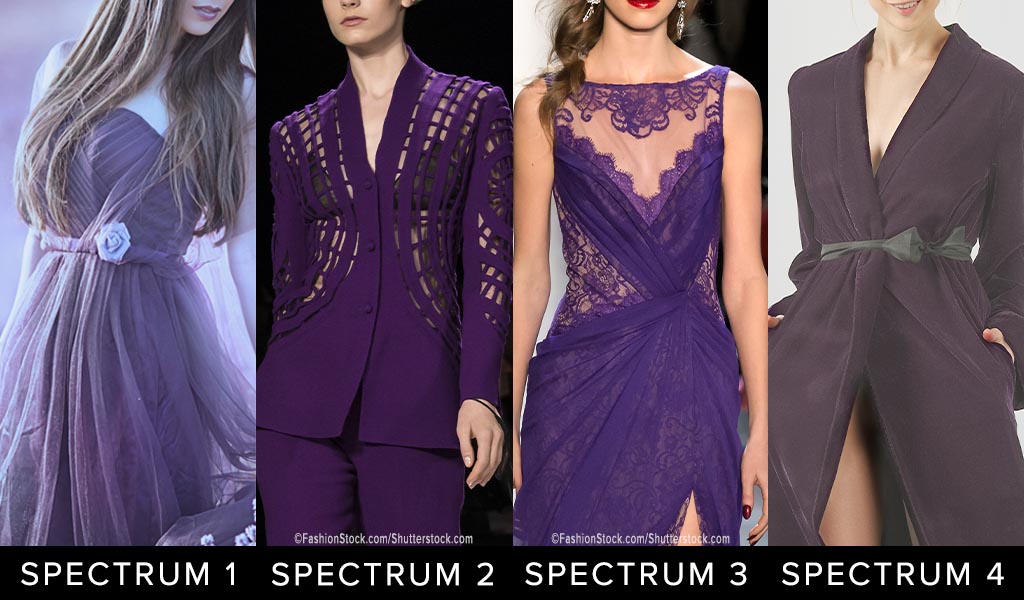
Notice the differences in the four C Color Spectrums:
- C Color Spectrum 1 Purple is Cool Blue Based, Less Saturated, Appears Rubbed with Ash
- C Color Spectrum 2 Purple is Cool Blue Based, More Saturated
- C Color Spectrum 3 Purple is Warm Yellow Based, Moderately Saturated
- C Color Spectrum 4 Purple is Warm Red Based, Less Saturated, Appears Rubbed with Earth
C Color has classified the myriad of colors in existence into four C Color Spectrums. The temperatures, saturations, and predominant bases of one of the primary colors of either blue, yellow, or red, are the three factors utilized to classify colors.
C Color is the only DNA predicated color analysis Methodology available.
Unlike the other theories, the C Color Ideology stems from an internal penchant rather than external features. With C Color, you can receive an accurate personal color analysis and choose colors on your own with confidence.
The Benefits Of Utilizing C Color®
Adopting the C Color Methodology can enable you to look, think, feel, act, learn, and heal your best. Wearing, utilizing, and living in your optimal colors can:
- Enhance your appearance
- Enable you to think more clearly
- Produce feelings of well-being
- Motivate you to act your best
- Assist you in absorbing new concepts more readily and distinctly
- Aid you in healing
Below is an example of a model in both C Color Spectrum 1, which is predominantly Cool Blue Ash Based, and C Color Spectrum 3, which is predominantly Warm Yellow Based.
Distinctively, when the model is clad in C Color Spectrum 3 colors, he has a flawless and glowing complexion, as the model, in reality, is within the C Color Spectrum 3 category.
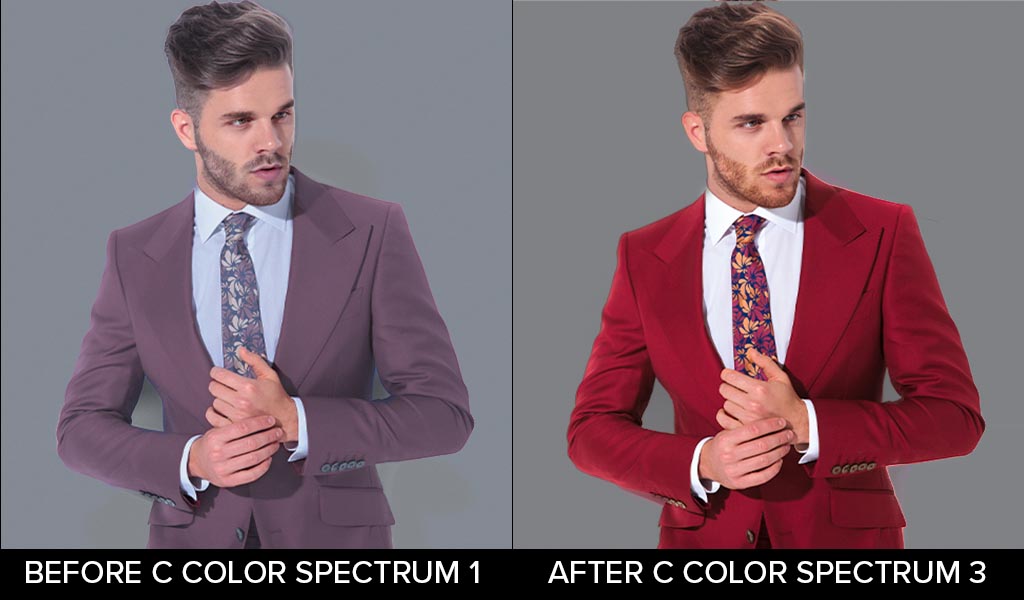 The After Photograph Displays Yellow Based Hair, Tie, And Jacket, Resulting In C Color Spectrum 3
The key to the classification of all colors is the temperature: cool or warm, saturation: less, more, or moderate, and predominant base of a primary color: blue, yellow, or red.
Please be sure to visit the C Color Website.
The refreshed C Color Website includes a plethora of engaging content, simple navigability, and instructive visuals representative of each C Color Spectrum.
C Color® has an online store to further direct you in your endeavor with colors.
Below are examples of how individuals from each of the four C Color Spectrums can wear lavender, burgundy, violet/purple, and grape colors.
Please note that clothing and accessory colors are for reference only and do not represent the models' C Color Spectrums.
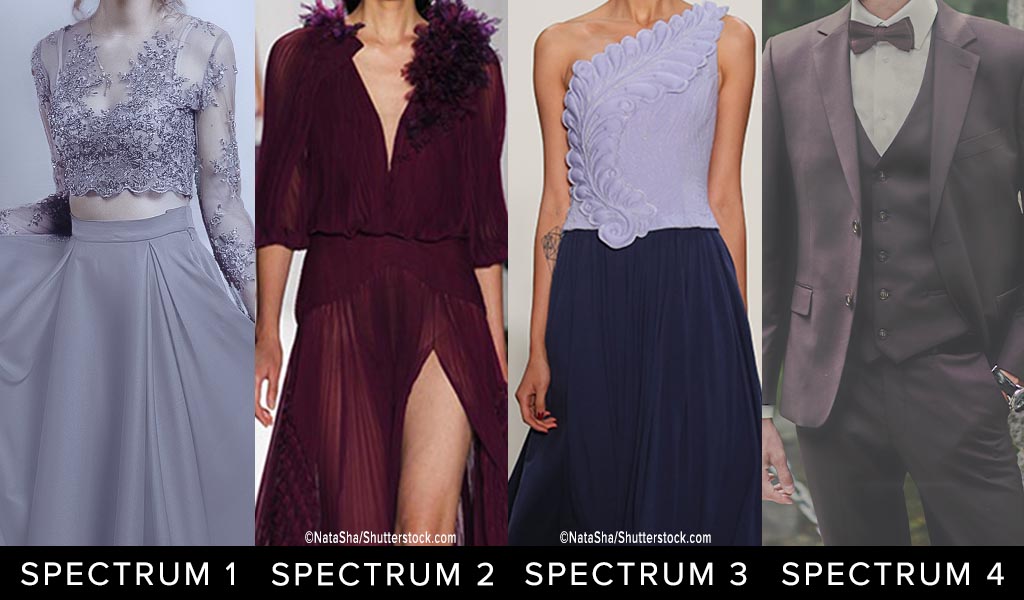
Notice the differences in the four C Color Spectrums:
- C Color Spectrum 1 Lavender is Cool Blue Based, Less Saturated, Appears Rubbed with Ash
- C Color Spectrum 2 Burgundy is Cool Blue Based, More Saturated
- C Color Spectrum 3 Violet and Purple are Warm Yellow Based, Moderately Saturated
- C Color Spectrum 4 Grape is Warm Red Based, Less Saturated, Appears Rubbed with Earth
The key to the classification of all colors is the temperature, saturation, and predominant base of one of the primary colors of blue, yellow, or red.
Browse the C Color Website and C Color Blog Posts for a colorful experience and inspiration regarding all things color.
Incorporate your C Color Spectrum colors into your wardrobe, living spaces, and beyond.
Ready To Get Started?
Look and feel prettier or more handsome; enjoy glowing skin; receive compliments; gain confidence; and garner color confidence.
C Color Gets You There!
Remember: Hair, Eye, and Skin Colors Don't Matter
"The first stab of love is like a sunset, a blaze of color." ...Anna Godbersen, Writer
Socialize With Us