What is color harmony?
One definition states that color harmony is a theory of combining colors in a fashion that is harmonious to the eye, such as colors that complement and blend well together.
For years, color harmony theories and definitions have centered around the color wheel.
How can you apply clear, logical rules to confidently create a harmonious color environment or wardrobe for yourself?
Read on to explore how the best practices generate color harmony.
Color Harmony And The Color Wheel
Most conventional color theorists, artists, or stylists refer to the color wheel when explaining how to gain color harmony.
A color wheel displays primary, secondary, and tertiary colors in a circle and illustrates the relationships between those colors. Individuals, when following color rules, may adhere to the color wheel relationships to coordinate outfits or decorate and design homes or offices.
The most common color wheel rules include:
- Monochromatic
- Analogous
- Complementary
- Triadic
- Split-Complementary
When faced with millions of color options, implementing these broad color constructs to guide your color resolutions can produce limiting and ineffective consequences.
Flaws With Traditional Color Harmony Theories
The color wheel provides loose guidelines for achieving color harmony. Fortunately, the traditional color rules are not the only method for creating harmonious color combinations.
Conventional color harmony rules can actually hinder your creativity and expression by limiting color usage to shades in a wheel. In addition, these rules assume that all individuals can wear or use the colors in a color wheel; however, millions of colors exist, so it is impossible for the color wheel to account for all of the colors in the world.
Moreover, people often confuse the temperatures, saturations, and predominant bases of colors. Color analysts, makeup artists, stylists, designers, and most other industry professionals categorize blues, greens, and purples as cool colors and reds, yellows, and oranges as warm colors; nevertheless, all colors can be cool or warm.
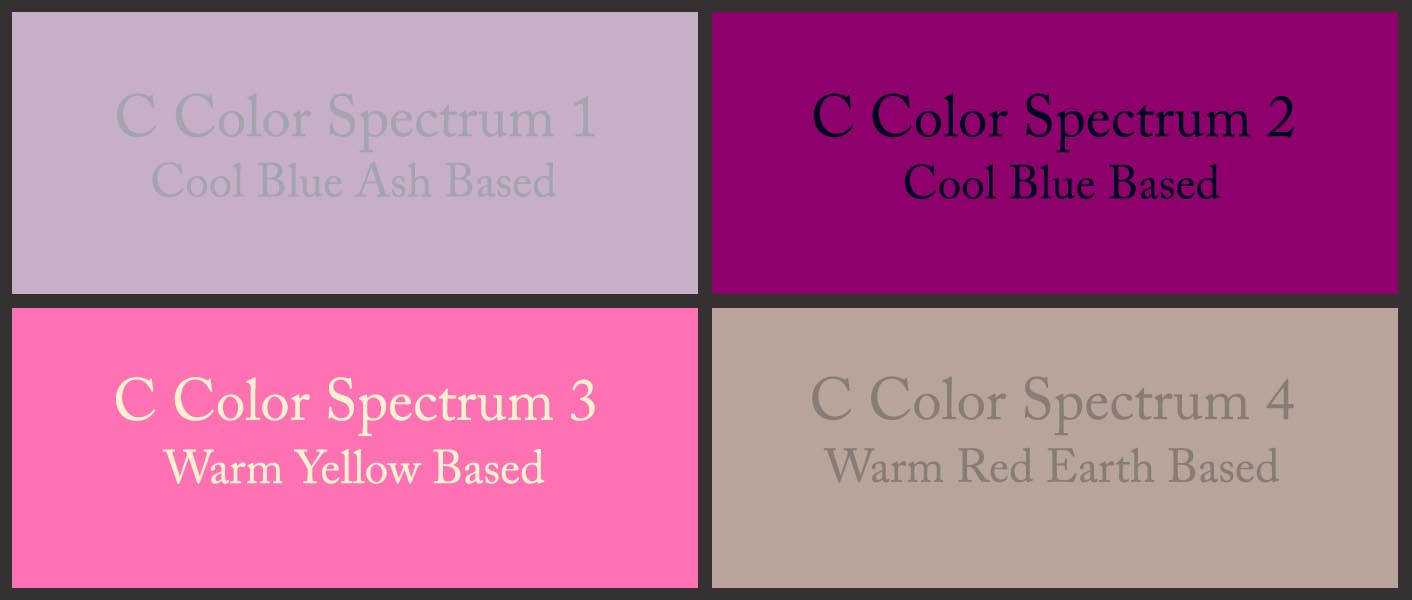
The above color quadrant displays a Cool Blue Ash Based pink color, a Cool Blue Based pink color, a Warm Yellow Based pink color, and a Warm Red Earth Based tan color, as examples to further distinguish the four C Color Spectrums. Each C Color Spectrum® contains millions of every color.
What is the best way to acquire color harmony and discern your natural partialities for color with 100% certainty?
C Color Teaches You To Look Inside For Color
A More Accurate Approach To Color Harmony
C Color® is a revolutionary, genetically-promoted approach to color harmony. With C Color®, you can identify your instinctive color predilections and effectuate color harmony.
The C Color Ideology is championed by a color gene within your DNA. In other words, you are born with native affinities toward color, and that can enable you to look, think, feel, act, learn, and heal your best.

C Color® defines color harmony as wearing and surrounding yourself with the colors within your C Color Spectrum®.
Aligning your color collection with your C Color Spectrum is the only way to execute color harmony, as all hues within your C Color Spectrum blend and correlate effortlessly.
There are 16.7 million known hex codes, or colors, in the world. Accordingly, color reconciliations can be perplexing. C Color has classified the myriad of colors into four C Color Spectrums®. The temperature, saturation, and predominant base of the color is paramount, as that determines the C Color Spectrum. Each color has a predominant base of one of the primary colors of blue, yellow, or red.
C Color® has an online store to further direct you in your endeavor with colors.
All individuals are classified into one of the four C Color Spectrums.
Below are examples of how individuals from each of the four C Color Spectrums can wear pink and nude colors.
Please note that clothing and accessory colors are for reference only and do not represent the models' C Color Spectrums.
NOTE: THIS COMPOSITE IS BEING UPDATED FOR COLOR ACCURACY
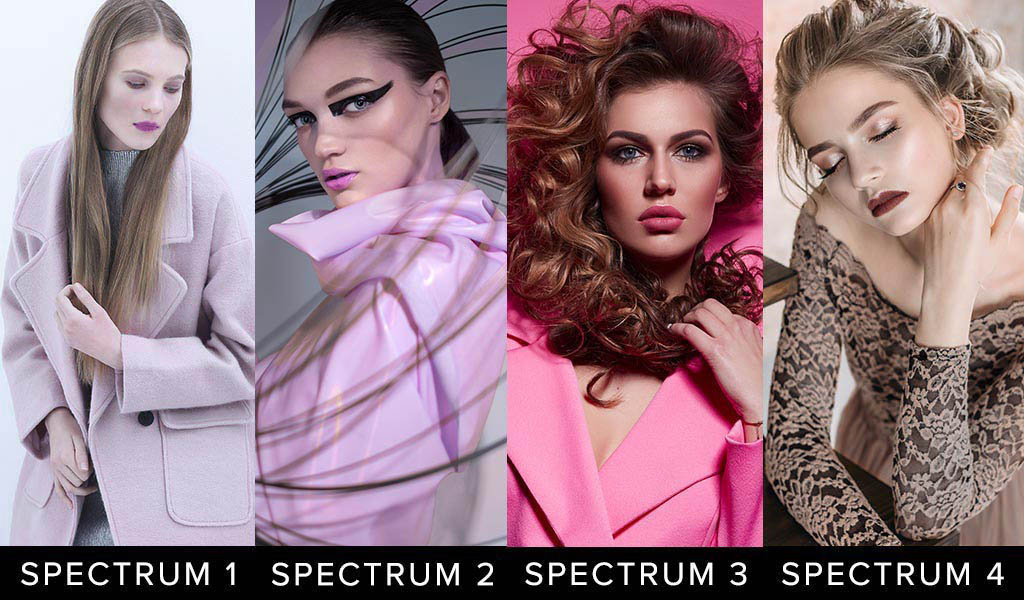
Notice the differences in the four C Color Spectrums:
- C Color Spectrum 1 Pink is Cool Blue Based, Less Saturated, Appears Rubbed with Ash
- C Color Spectrum 2 Pink is Cool Blue Based, More Saturated
- C Color Spectrum 3 Pink is Warm Yellow Based, Moderately Saturated
- C Color Spectrum 4 Nude is Warm Red Based, Less Saturated, Appears Rubbed with Earth
The key to the classification of all colors is the temperature, saturation, and predominant base of one of the primary colors of blue, yellow, or red.
In General, The Color Pink Does Not Appeal To Individuals Within C Color Spectrum 4; Thereupon The Color Of Nude Is Displayed
Interestingly enough, the colors in the color wheel seem to only consist of the colors that are within C Color Spectrum 3. The question then becomes: Where are the colors of the other three C Color Spectrums?
C Color asserts that the traditional color wheels are incomplete.
Achieve Color Harmony With C Color®
C Color® is the first and only company to quantify intuitive color preferences. Quantifying intuitive color inclinations is the specialty of our lifestyle technology company.
The C Color® Ideology and Methodology will lead you in living your life in your unrivaled color environment.
All human beings embody the virtue of color intelligence, although most people are not cognizant of that fact. The only other color theory relies on the external features of individuals, as in hair colors, eye colors, and complexion colors.
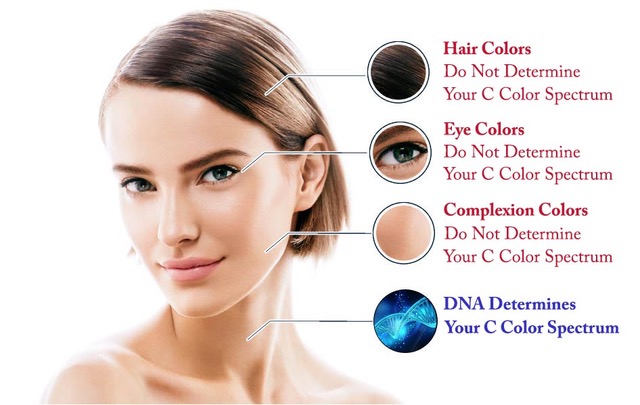
C Color® does not take external features, such as hair, eye, or complexion colors, into consideration, as these features are inconsequential when determining your native color penchant.
C Color was created to enable people to tap into their immanent color tendencies with the utilization of a DNA foundational framework. By eliminating the influence of external factors, the Personal C Color Analysis facilitates the uncovering of your laudable colors and distinguishes them in your environment.
To verify your C Color Spectrum®, take the five-minute C Color Quiz. The objective of the C Color Quiz is to select the color quadrant that immediately catches your eye. In doing so, you are following your born with propensity for color. Thinking about your color prerogatives will skew your aftereffect, as the accurate conclusion is established by intuitive selections, not thought directives.
Due to this reason, receiving a Personal C Color Analysis differs from all others on the market.
The efficacy of the C Color Quiz is 99.8%. We do not guarantee hundred percent efficacy, as clients may not consistently follow their innate preferences or intuition throughout the C Color Quiz.
Below are examples of how individuals from each of the four C Color Spectrums can wear lavender, burgundy, white/pink, and beige pattern colors.
Please note that clothing and accessory colors are for reference only and do not represent the models' C Color Spectrums.
NOTE: THIS COMPOSITE IS BEING UPDATED FOR COLOR ACCURACY
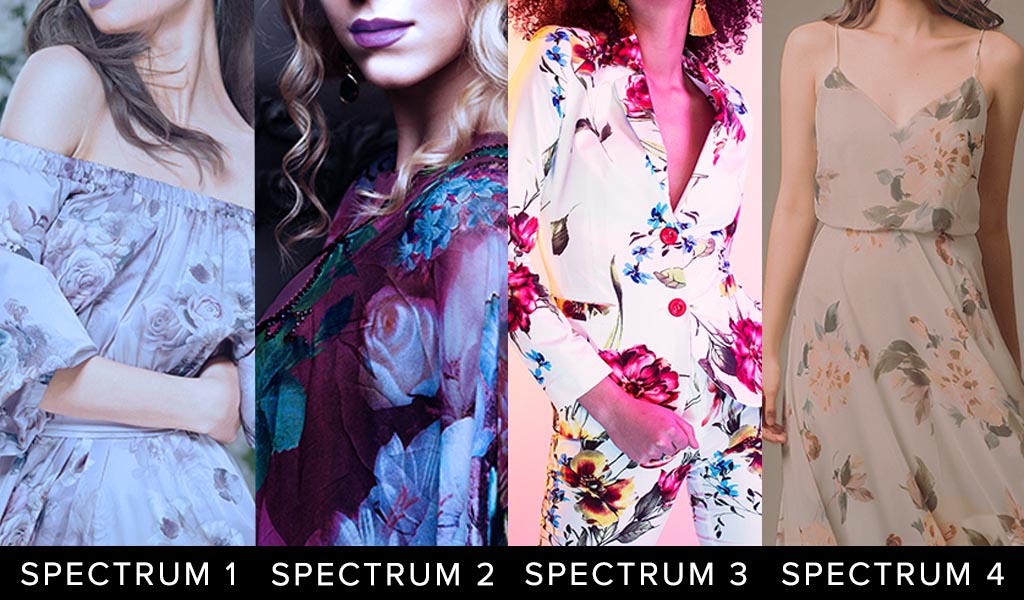
Notice the differences in the four C Color Spectrums;
- C Color Spectrum 1 Lavender Pattern is Cool Blue Based, Less Saturated, Appears Rubbed with Ash
- C Color Spectrum 2 Burgundy Pattern is Cool/Blue Based, More Saturated
- C Color Spectrum 3 White and Pink Pattern is Warm/Yellow Based, Moderately Saturated
- C Color Spectrum 4 Beige Pattern is Warm Red Based, Less Saturated, Appears Rubbed with Earth
The key to the classification of all colors is the temperature, saturation, and predominant base of one of the primary colors of blue, yellow, or red.
In General, The Color Pink Does Not Appeal To Individuals Within C Color Spectrum 4; Thereupon The Color Of Beige Is Displayed
Please be sure to visit the C Color Website.
The refreshed C Color Website includes a plethora of engaging content, simple navigability, and instructive visuals representative of each C Color Spectrum.
Browse the C Color Website and C Color Blog Posts for a colorful experience and inspiration regarding all things color.
Apply Color Harmony To All Areas Of Your Life
Once all the colors in your closet are within your C Color Spectrum®, creating a wardrobe will be effortless, as you will have attained color harmony. In other words, clothes coordinate and blend with ease, subsequently offering convenience.
All colors in your C Color Spectrum® share the same temperature, saturation, and predominant base of either blue, yellow, or red. These three factors are why the garments and accessories synchronize easily and color harmony is accomplished. With C Color, you will no longer have to consult a color wheel and settle for colors that may not be appealing to you.
The challenge then becomes: how do you choose from the numerous alternatives of unparalleled colored clothing ensembles that you can create?
Below are examples of how individuals from each of the four C Color Spectrums can wear pink, fuchsia, blush, and taupe colors.
Please note that clothing and accessory colors are for reference only and do not represent the models' C Color Spectrums.
NOTE: THIS COMPOSITE IS BEING UPDATED FOR COLOR ACCURACY
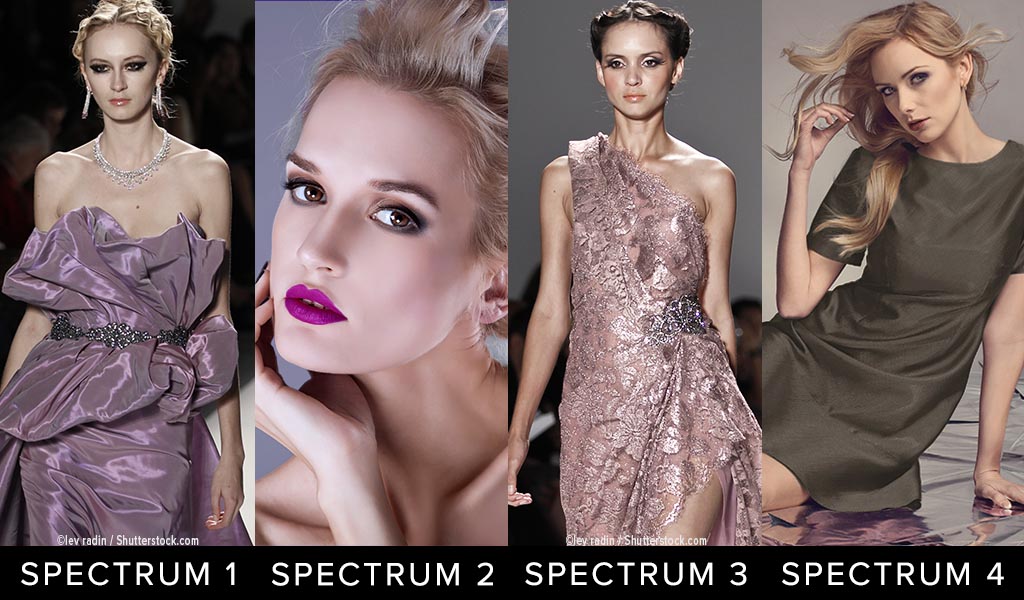
Notice the differences in the four C Color Spectrums:
- C Color Spectrum 1 Pink is Cool Blue Based, Less Saturated, Appears Rubbed with Ash
- C Color Spectrum 2 Fuchsia is Cool Blue Based, More Saturated
- C Color Spectrum 3 Blush is Warm Yellow Based, Moderately Saturated
- C Color Spectrum 4 Taupe is Warm Red Based, Less Saturated, Appears Rubbed with Earth
The key to the classification of all colors is the temperature, saturation, and predominant base of one of the primary colors of blue, yellow, or red.
In General, The Color Pink Does Not Appeal To Individuals Within C Color Spectrum 4; Thereupon, The Color Of Taupe Is Displayed
The best practice is to select your favorite outfit to wear first. Then, as new occasions arise, experiment with other apparel. In the end, you will find that your wardrobe is maximized exponentially.
Living and surrounding yourself with the colors within your C Color Spectrum® will create atmospheres conducive to your well-being and harmonize with all of the other parts of your world.
The C Color® Ideology is applicable in all arenas. Take advantage of it when making color determinations for your wardrobe, accessories, cosmetics, home, office, automobile interiors/exteriors, paint, and everything else in your world. Your belongings will intermix with simplicity, enabling you to live your life in your genetically preferred colors.
Get Started Today With C Color®
The exemplary colors can enhance your appearance, can enable you to think more clearly, can produce feelings of well-being, can motivate you to act your best, can assist you in absorbing new concepts more readily and distinctly, and can aid you in healing.
Below is an example of a model in both C Color Spectrum 1, which is predominantly Cool Blue Based, and C Color Spectrum 3, which is predominantly Warm Yellow Based.
Distinctively, when the model is clad in C Color Spectrum 3 colors, she has a flawless and glowing complexion, as the model, in reality, is within the C Color Spectrum 3 category.
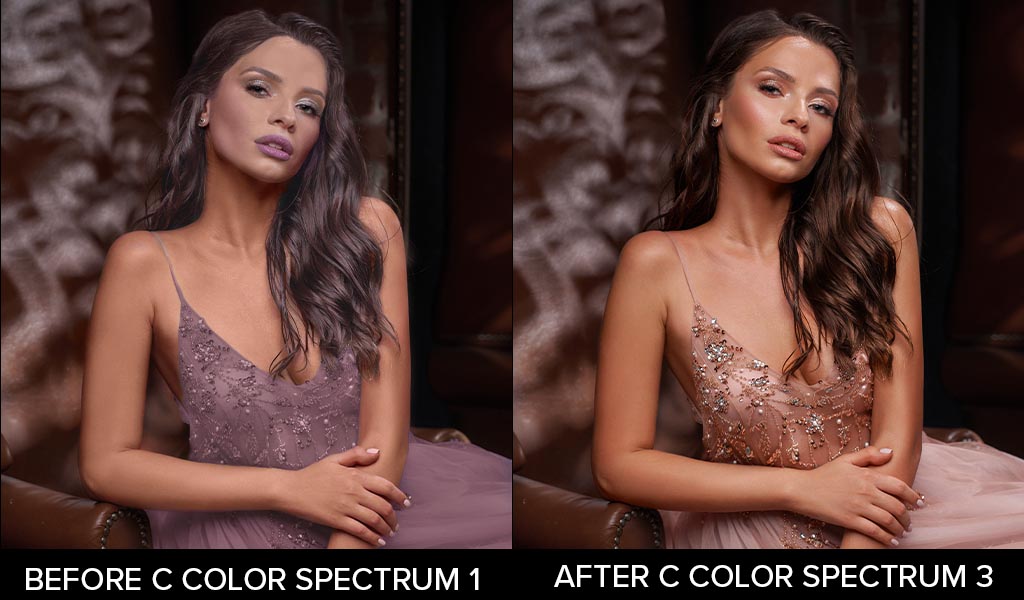 The After Photograph Displays Yellow Based Hair, Makeup, and Dress, Resulting In C Color Spectrum 3
The key to the classification of all colors is the temperature: cool or warm, saturation: less, more, or moderate, and predominant base of a primary color: blue, yellow, or red.
C Color® supports you in achieving overall harmony by tapping into your latent color proclivities.
Sign up to become aware of your proneness for color by releasing the secrets of your DNA.
C Color® conquers the color conundrum and teaches you to implement color successfully in all avenues of your life!
Look and feel prettier or more handsome; experience glowing skin; receive compliments; gain confidence; and garner color confidence.
C Color Gets You There!
Remember: Hair, Eye, and Skin Colors Don't Matter
Socialize With Us