Color analysis apps are emerging to instruct individuals with the daily navigation of color. It is important to realize that understanding and wielding the powerful tool of color can enhance all aspects of your life.
Below, we discuss three color analysis apps that may be beneficial.
- My Best Colors App
- My Color Palette App
- Dressika App
What Are Color Analysis Apps?
Customarily, color analysis apps are designed to analyze colors and color groups. Typically, color analysis apps are of interest to individuals who desire support with wardrobe colors, décor colors, paint colors, and other color decisions.
Certain color analysis apps provide questionnaires to clients to identify color palettes.
For the most part, there are only two color analysis theories: the internal DNA implied C Color® Ideology and the external features supposition.
The following three external color analysis apps listed below resort to hair, eye, and complexion colors, as the determining criteria for the recommendation of colors to clients.
Below, the three color analysis applications and the distinctions concerning each are analyzed.
3 Color Analysis Apps
1. My Best Colors App
The My Best Colors App, created by Colorwise.me, is a self color analysis application that is established from the seasonal color analysis theory and approach.
Smart Color Picker analyzes the colors of garments and objects. The Color Matching Mode searches for a color that is most similar to a color in the palette of the client. The Overlay Mode freezes the color of the square swatch to conclude how the captured color and favored color coordinate. Manual toggling between the seasons is an option.
Included in the app are the Classic palettes from the 4 season color system.
Premium palettes are offered via the 12 season color system. A 6 palette set is available for each corresponding subtype: Best Colors, Complementary Colors, Neutral Colors, Jewelry Colors, Eyeshadow Colors, and Lipstick Colors.
How To Utilize My Best Colors App
- Self Determine Color Palette By Moving Cursor To Prominent Areas Of Hair, Face, Eyes
- Import Custom Palette From colorwise.me And Social Networking colorwise.me Sites
- Point Smart Color Picker Camera At Item For Color Assessment
Tips And Insight
- 30 Personal Colors Supplied
- Paid For Additional Colors Option
- Lighting Requires Auto White Balance And Flash
- Digital Color Analysis Changes Vastly, Subjective Nature Of Seasonal Color System Ends In Contrary Outcomes, Hair Colors, Eye Colors, Skin Colors Can Change
2. My Color Palette App
The My Color Palette App is a fashion color stylist that employs the seasonal color analysis approach.
A questionnaire is provided regarding hair and eye color contrast, and skin temperature. The hair and eye categories are light contrast, medium contrast and strong contrast. The skin categories are warm and cool.
A personalized seasonal color palette is generated for the client. Clicking on generated app colors draws the client to the Pinterest platform. Photographs of the culled client colors are displayed in "fashion street style" apparel.
How To Utilize My Color Palette App
- Take Quiz To Determine Color Palette
- Click On Generated App Colors For Suggested Attire
Tips And Insight
- Latest Color Trends And Colors That Match Client's Season Provided, Including Corresponding Makeup Colors
- Subjective Nature Of Seasonal Color System Concludes In Conflicting Consequences, Hair Colors, Eye Colors, Skin Colors Can Change
3. Dressika: Seasonal Colors App
Dressika acts as a personal fashion assistant and virtual fitting room. The app makes use of the seasonal color analysis approach to create a Look Book.
Over one hundred colors from the seasonal color palette of a client are chosen to create the Look Book. Personal Look Books can also be established.
The virtual fitting room provides the ability to physically assess the apparel from online stores prior to purchase.
How To Utilize The Dressika App
- Take Seasonal Color Test
- Peruse Look Book For Colors, Styling, Attire
- Store Ensembles In Virtual Wardrobe
- Take Self Photograph, Clothes Photographs, Import Screenshot Of Considered Items For Virtual Fitting Room Attire Assessment
- Add Palette Colors From Color Wheel
Tips And Insight
- Unlimited Photographs, One Hundred Colors Provided With Lifetime Subscription Fee
- App Combines Photos Of Self And Clothing
- Proper Lighting Necessary For Self, Clothing Photographs
- Subjective Nature Of Seasonal Color System Produces Incongruent Aftereffects, Hair Colors, Eye Colors, Skin Colors Can Change
Select The Accurate C Color Analysis App
Quantifying intuitive color inclinations is the specialty of C Color®, and that Ideology and the C Color® Methodology will support you in living life in your optimal color environment once your C Color Spectrum® has been established.
As mentioned, a C Color Spectrum is a category of a myriad of colors classified by temperature, saturation, and the predominant base of a primary color of either Blue, Yellow, or Red.
Exterior features focused color analysis apps have brought attention to the significance of color; however, it is essential to understand the limitations of the seasonal analysis theory and system.
Season color analysis whether with a consultant or an applications does not account for a color gene within your DNA.
The colors of external features and external biases, such as fashion trends or the opinions of friends and family, can influence daily color guidance and steer individuals far from the colors that are optimal.
People often confuse the temperatures, saturations, and predominant bases of colors. Color analysts, makeup artists, stylists, designers, and most other industry professionals categorize blues, greens, and purples as cool colors and reds, yellows, and oranges as warm colors; nevertheless, all colors can be cool or warm.
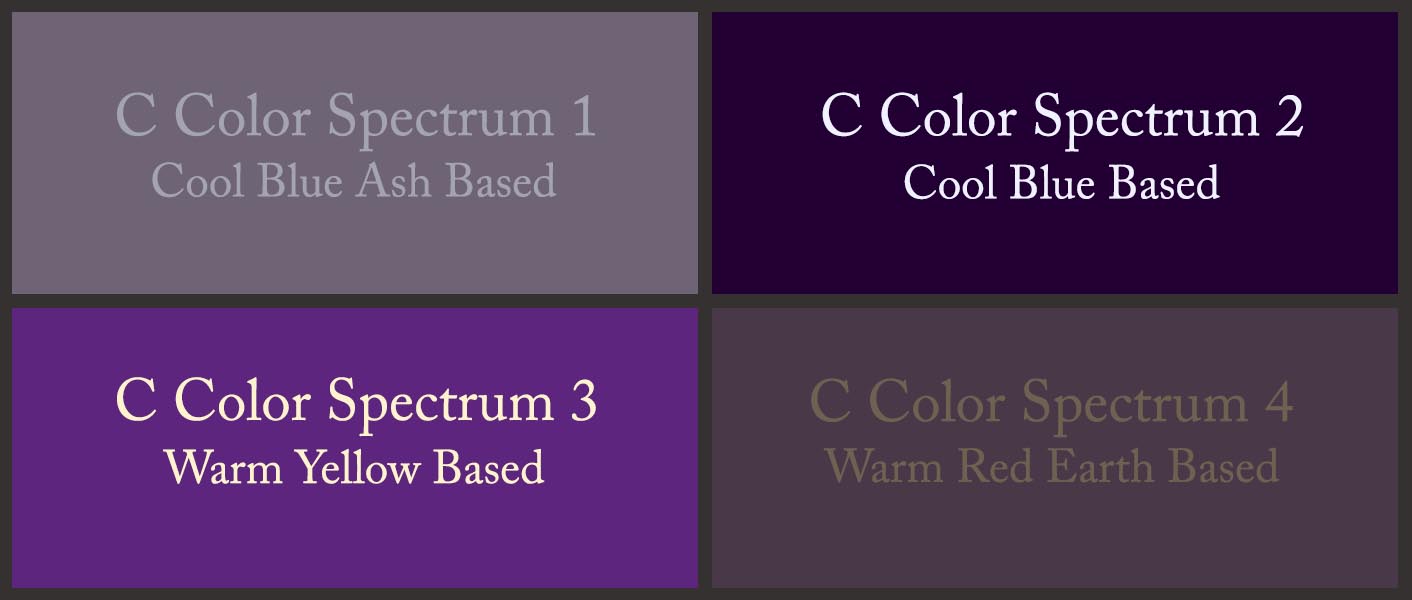
The above color quadrant displays a Cool Blue Ash Based purple color, a Cool Blue Based purple color, a Warm Yellow Based purple color, and a Warm Red Earth Based purple color, as examples to further distinguish the four C Color Spectrums. Each C Color Spectrum® contains millions of every color.
Below is an example of a model in both C Color Spectrum 4, which is predominantly Warm Red Earth Based, and C Color Spectrum 3, which is predominantly Warm Yellow Based.
Distinctively, when the model is clad in C Color Spectrum 3 colors, he has a flawless and glowing complexion, as the model, in reality, is within the C Color Spectrum 3 category.
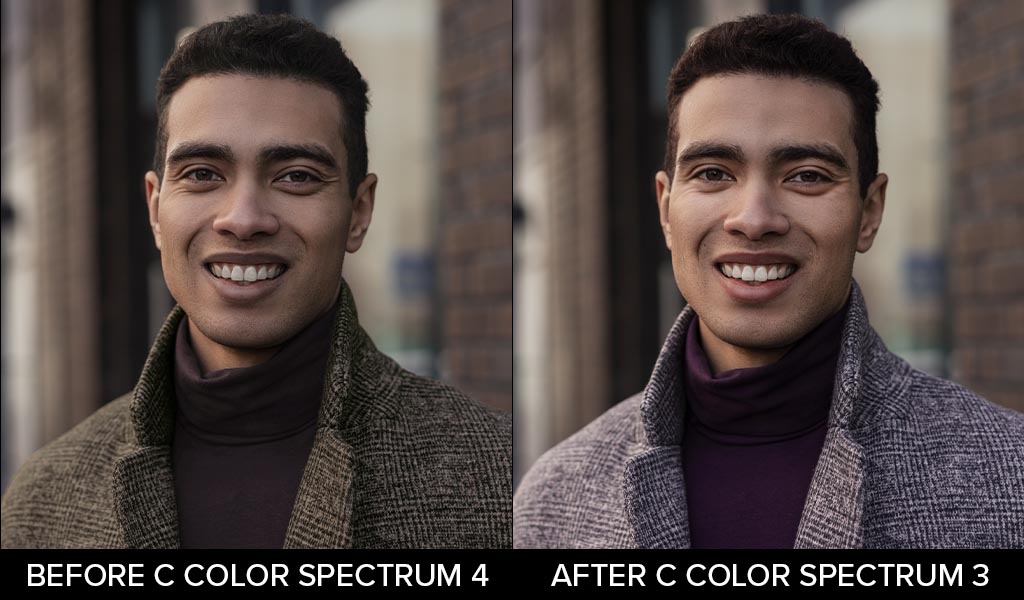 The After Photograph Displays Yellow Based Hair, Coat, And Sweater, Resulting In C Color Spectrum 3
The key to the classification of all colors is the temperature: cool or warm, saturation: less, more, or moderate, and predominant base of a primary color: blue, yellow, or red.
C Color® is the only DNA empowered color analysis method. The C Color system identifies the colors that can enable you to look, think, feel, act, learn, and heal your best.
Please be sure to visit the C Color Website.
The refreshed C Color Website includes a plethora of engaging content, simple navigability, and instructive visuals representative of each C Color Spectrum.
Below is the first example of how individuals from each of the four C Color Spectrums can wear purple, violet, and grape colors.
Please note that clothing and accessory colors are for reference only and do not represent the models' C Color Spectrums.
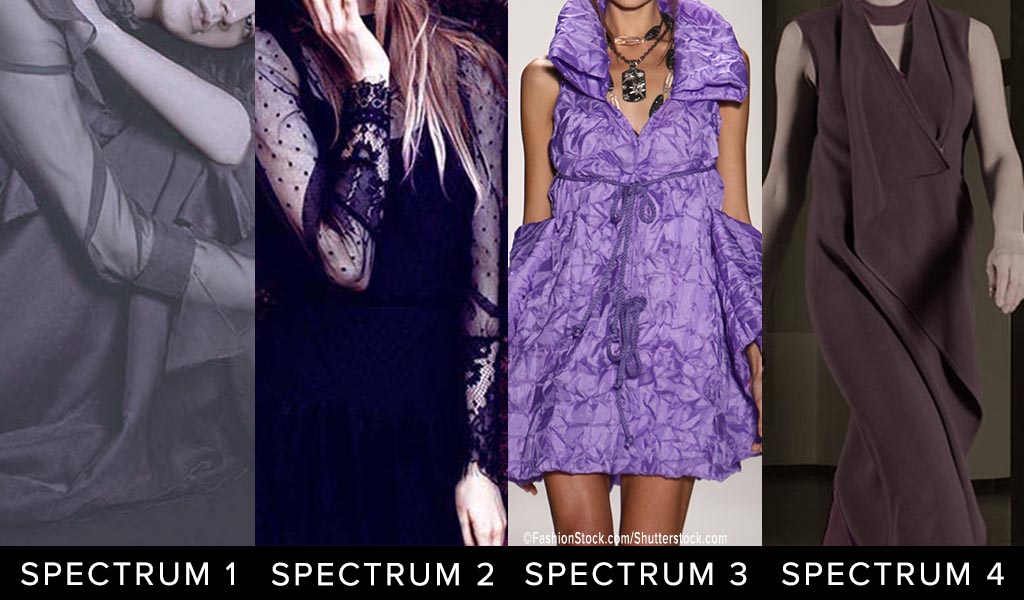
Notice the differences in the four C Color Spectrums:
- C Color Spectrum 1 Purple is Cool Blue Based, Less Saturated, Appears Rubbed with Ash
- C Color Spectrum 2 Purple is Cool Blue Based, More Saturated
- C Color Spectrum 3 Violet is Warm Yellow Based, Moderately Saturated
- C Color Spectrum 4 Grape is Warm Red Based, Less Saturated, Appears Rubbed with Earth
The key to the classification of all colors is the temperature, saturation, and predominant base of one of the primary colors of blue, yellow, or red.
Browse the C Color Website and C Color Blog Posts for a colorful experience and inspiration regarding all things color.
Below is the second example of how individuals from each of the four C Color Spectrums can wear lavender, purple, and grape colors.
Please note that clothing and accessory colors are for reference only and do not represent the models' C Color Spectrums.
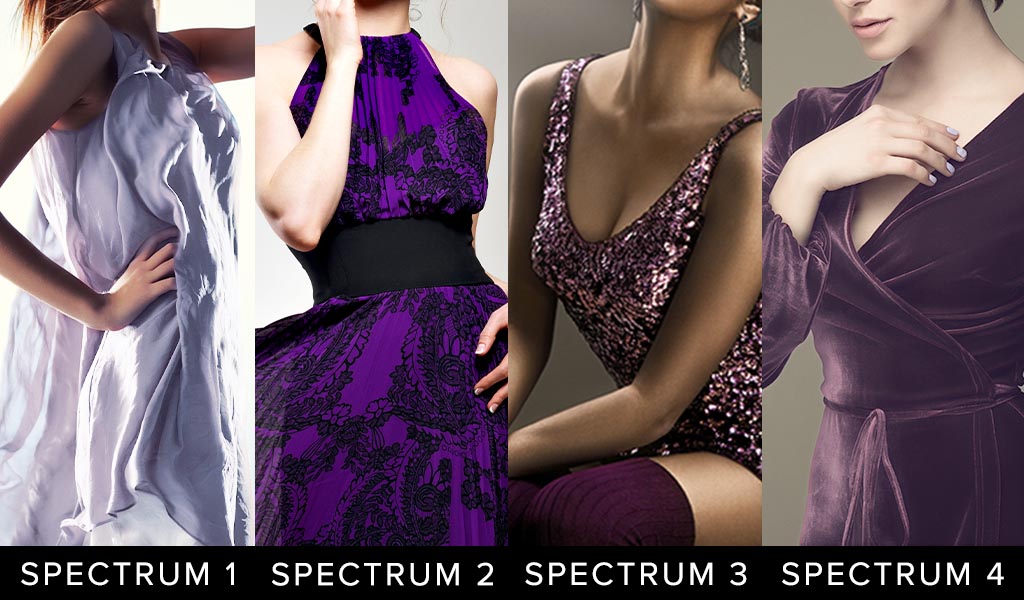
Notice the differences in the four C Color Spectrums:
- C Color Spectrum 1 Lavender is Cool Blue Based, Less Saturated, Appears Rubbed with Ash
- C Color Spectrum 2 Purple is Cool Blue Based, More Saturated
- C Color Spectrum 3 Purple is Warm Yellow Based, Moderately Saturated
- C Color Spectrum 4 Grape is Warm Red Based, Less Saturated, Appears Rubbed with Earth
The key to the classification of all colors is the temperature, saturation, and predominant base of one of the primary colors of blue, yellow, or red.
C Color® has an online store to further direct you in your endeavor with colors.
Wearing and utilizing colors within your C Color Spectrum can enhance your appearance, can enable you to think more clearly, can produce feelings of well-being, can motivate you to act your best, can assist you in absorbing new concepts more readily and distinctly and can aid you in healing.
Look and feel prettier or more handsome, achieve glowing skin, receive compliments, gain confidence, and garner color confidence.
C Color Gets You There!
Remember: Hair, Eye, and Skin Colors Don't Matter
Ready To Experience The C Color® Difference?
"The range in brightness from the purple glow of the sunset to the dark sky above is too great for most films, and naturally it is beyond the range of printed pictures."
— James Elkins, Art Professor and Author
Socialize With Us