
Summer can be considered a time for a change of pace, a change of appearance, and a change of scenery. Ideally, your stress levels lessen, the changes are reflected in your visual aspect, state of mind, and emotional well-being, and you enjoy more time out of doors with nature and under the sun.
This change of season and change of circumstances necessitate a lighter wardrobe.
Which colors are the most ideal for your summer wardrobe?
Today, we will assess popular color choices for summer fashion and explain how you can verify the optimal summer colors for yourself.
"What Are Summer Colors?"
Summer color trends change yearly. A search result will yield a variety of opinions ranging from yellows to blues to purples.
For example, trend forecaster and color matching tool company Pantone suggests incorporating the following colors, among others, into summer wardrobes, design, and décor:
- Orange
- Orange Red
- Coral
- Gold
- Yellow
- Royal Blue
- Moss Green
- Lilac Pink
The challenge with the above approach is that not all individuals wear the colors mentioned.
Orange, Orange/Red, Coral, Gold, and Lilac Pink are only worn by a portion of the population.
The colors of yellow, royal blue, and moss green are worn by the entire population; although, individuals wear each of the above mentioned colors with a different temperature: cool or warm, saturation: less, more or moderately, and predominant primary color base: blue, yellow or red.
The confusion of the above three factors can be troublesome when imparting color advice. Color analysts, makeup artists, stylists, designers, and most other industry professionals categorize blues, greens, and purples as cool colors and reds, yellows, and oranges as warm colors; nevertheless, all colors can be cool or warm.
All colors mentioned above can be both cool or warm, as there are 16.7 million identified colors in the world.
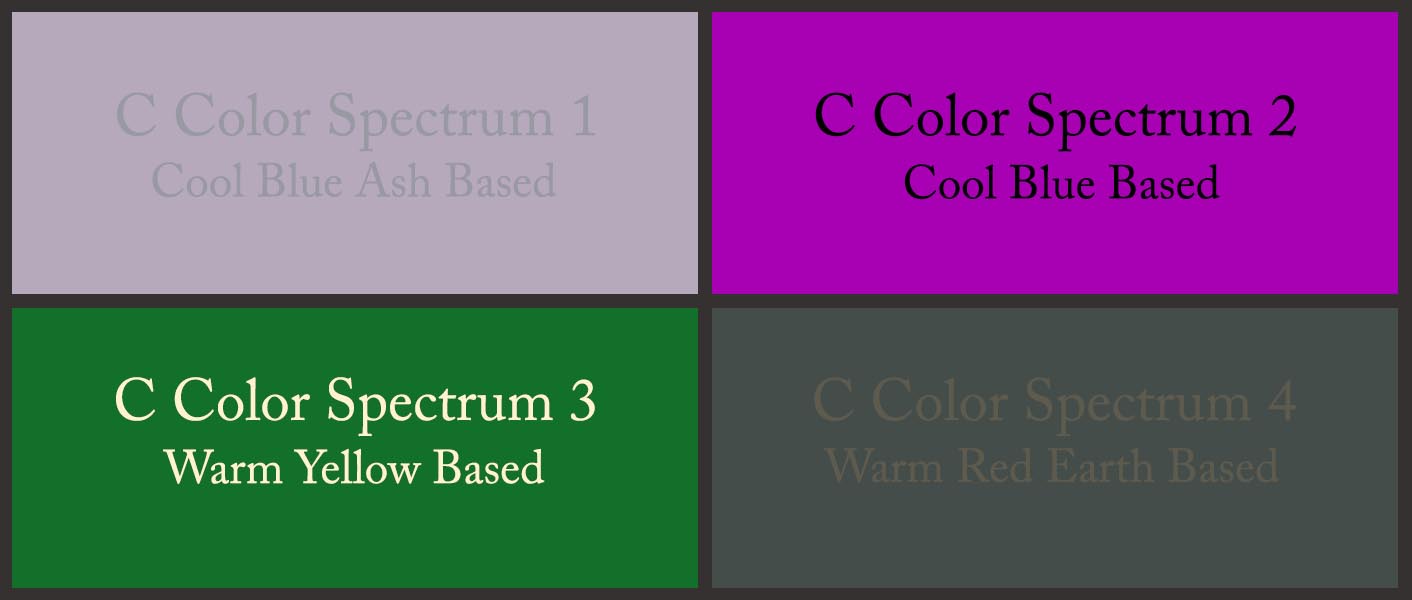
The above color quadrant displays a Cool Blue Ash Based lavender color, a Cool Blue Based fuchsia color, a Warm Yellow Based green color, and a Warm Red Earth Based green color, as examples to further distinguish the four C Color Spectrums. Each C Color Spectrum® contains millions of every color.
Other trend forecasters recommend wearing pastel colors, such as lavender or pale blue, during the spring and summer seasons; however, there is a common misconception regarding pastel colors.
Most individuals think pastels are light hues that are cool in nature. In actuality, pastel colors are defined as powdered pigments and are available in all colors, with the dark hues consisting of pure pigments and others with varying mixtures of inert whites.
"How To Wear And Employ Summer Colors"
Below are a few suggestions regarding incorporating lighter or strongly pigmented colors that are ideal for summer into your wardrobe and world.
WOMEN: Light Colored Summer Dresses With Strongly Pigmented Earrings, Necklaces, Bracelets, Rings, Handbags, And Sandals Or Strongly Pigmented Dresses With Light Colored Accessories
Below are examples of how individuals from each of the four C Color Spectrums can wear gray, pink, green/red/white/aqua patterned, and tan/navy patterned colors.
Please note that clothing and accessory colors are for reference only and do not represent the models' C Color Spectrums.

Notice the differences in the four C Color Spectrums:
- C Color Spectrum 1 Gray is Cool Blue Based, Less Saturated, Appears Rubbed with Ash
- C Color Spectrum 2 Burgundy is Cool Blue Based, More Saturated
- C Color Spectrum 3 Green, Red, White, and Aqua are Warm Yellow Based, Moderately Saturated
- C Color Spectrum 4 Tan and Navy are Warm Red Based, Less Saturated, Appear Rubbed with Earth
The key to the classification of all colors is the temperature, saturation, and predominant base of one of the primary colors of blue, yellow, or red.
MEN: Light Colored Suits With Colored Or Patterned Shirts Or Moderately Pigmented Ties
Below are examples of how individuals from each of the four C Color Spectrums can wear blue, navy, turquoise, and tan colors.
Please note that clothing and accessory colors are for reference only and do not represent the models' C Color Spectrums.
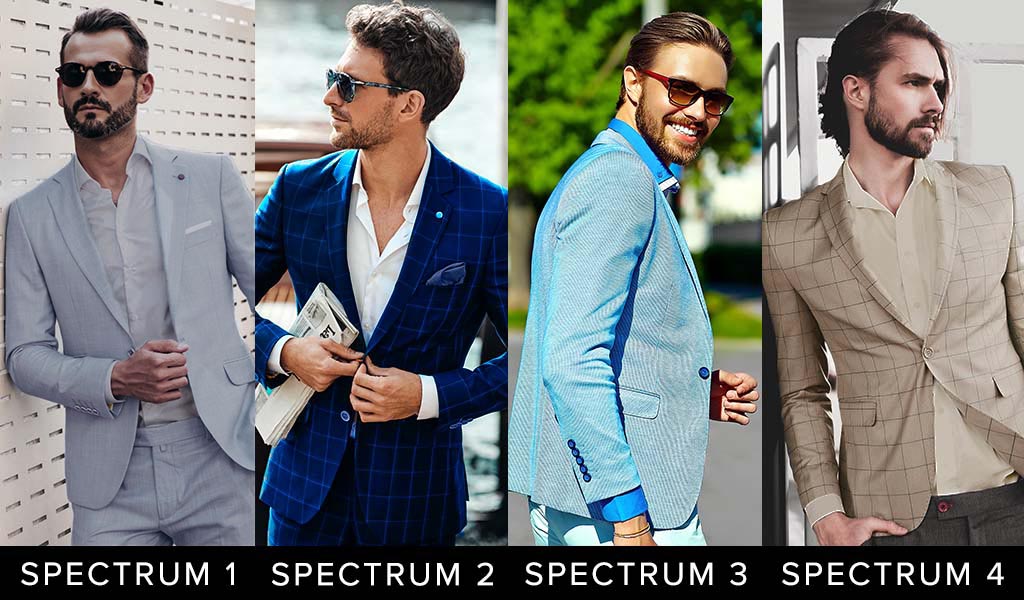
Notice the differences in the four C Color Spectrums:
- C Color Spectrum 1 Blue is Cool Blue Based, Less Saturated, Appears Rubbed with Ash
- C Color Spectrum 2 Navy is Cool Blue Based, More Saturated
- C Color Spectrum 3 Turquoise is Warm Yellow Based, Moderately Saturated
- C Color Spectrum 4 Tan is Warm Red Based, Less Saturated, Appears Rubbed with Earth
The key to the classification of all colors is the temperature, saturation, and predominant base of one of the primary colors of blue, yellow, or red.
COSMETICS: Soft Or More Colorful Eyeshadows For Surrounding Areas Of The Eye And Soft Colored Foundations, Blushes, Lipsticks For Face, Cheeks, And Lips
Below are examples of how individuals from each of the four C Color Spectrums can wear cosmetic colors.
Please note that cosmetic colors are for reference only and do not represent the models' C Color Spectrums.
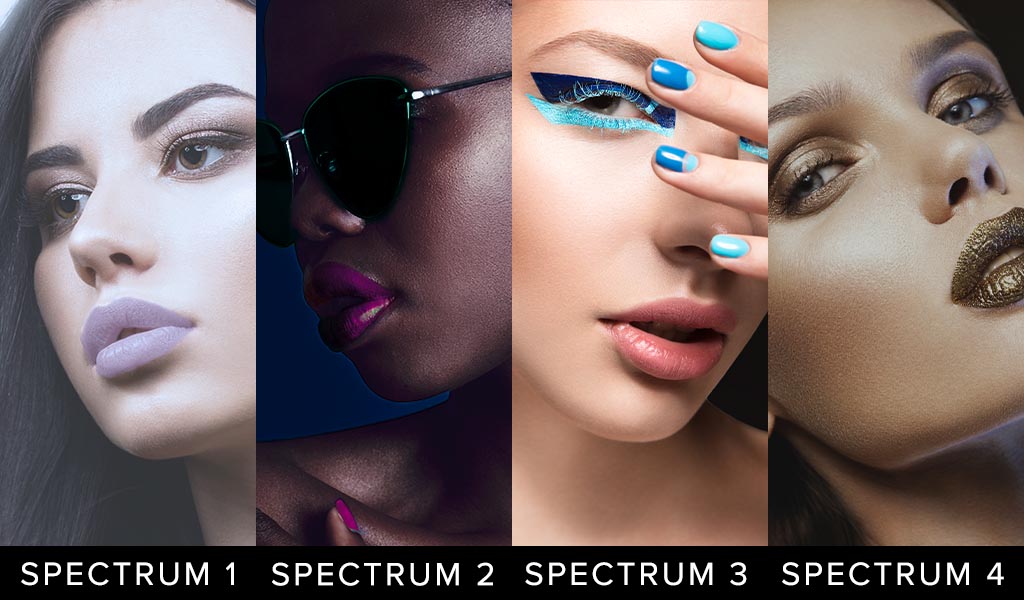
Notice the differences in the four C Color Spectrums:
- C Color Spectrum 1 Lavender is Cool Blue Based, Less Saturated, Appears Rubbed with Ash
- C Color Spectrum 2 Burgundy is Cool Blue Based, More Saturated
- C Color Spectrum 3 Blue and Peach are Warm Yellow Based, Moderately Saturated
- C Color Spectrum 4 Gold and Bronze are Warm Red Based, Less Saturated, Appear Rubbed with Earth
The key to the classification of all colors is the temperature, saturation, and predominant base of one of the primary colors of blue, yellow, or red.
NAIL POLISH: Soft Colored Polishes
Below are examples of how individuals from each of the four C Color Spectrums can wear nail polish colors.
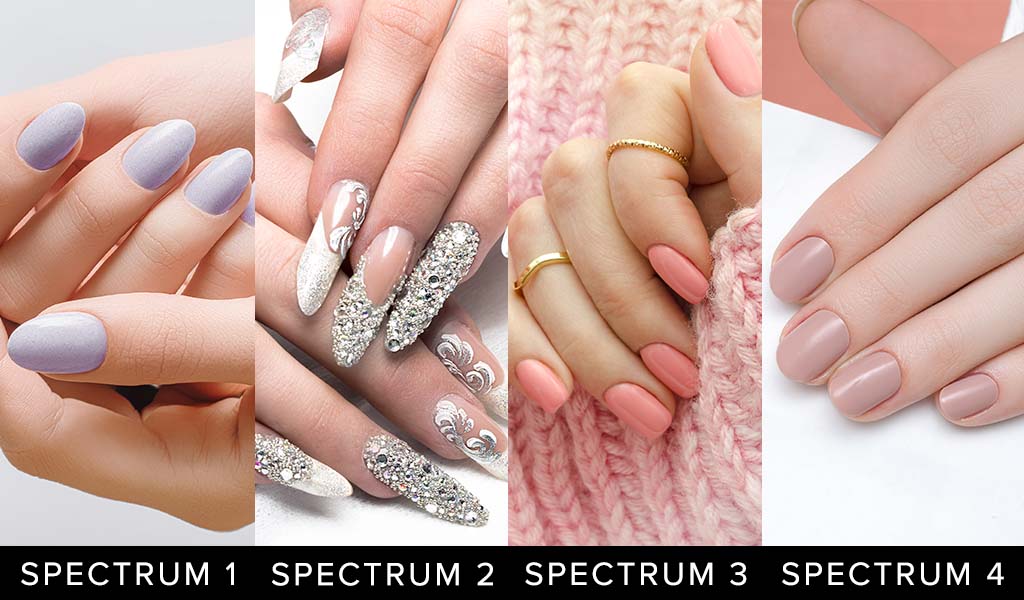
Notice the differences in the four C Color Spectrums:
- C Color Spectrum 1 Lavender is Cool Blue Based, Less Saturated, Appears Rubbed with Ash
- C Color Spectrum 2 Silver is Cool Blue Based, More Saturated
- C Color Spectrum 3 Pink/Peach is Warm Yellow Based, Moderately Saturated
- C Color Spectrum 4 Beige is Warm Red Based, Less Saturated, Appears Rubbed with Earth
The key to the classification of all colors is the temperature, saturation, and predominant base of one of the primary colors of blue, yellow, or red.
HOME DÉCOR: Lighter Appointments Or Patterned Appointments; Pillows, Throw Rugs, Other Interchangeable Items
Below are examples of home environments for each of the four C Color Spectrums.
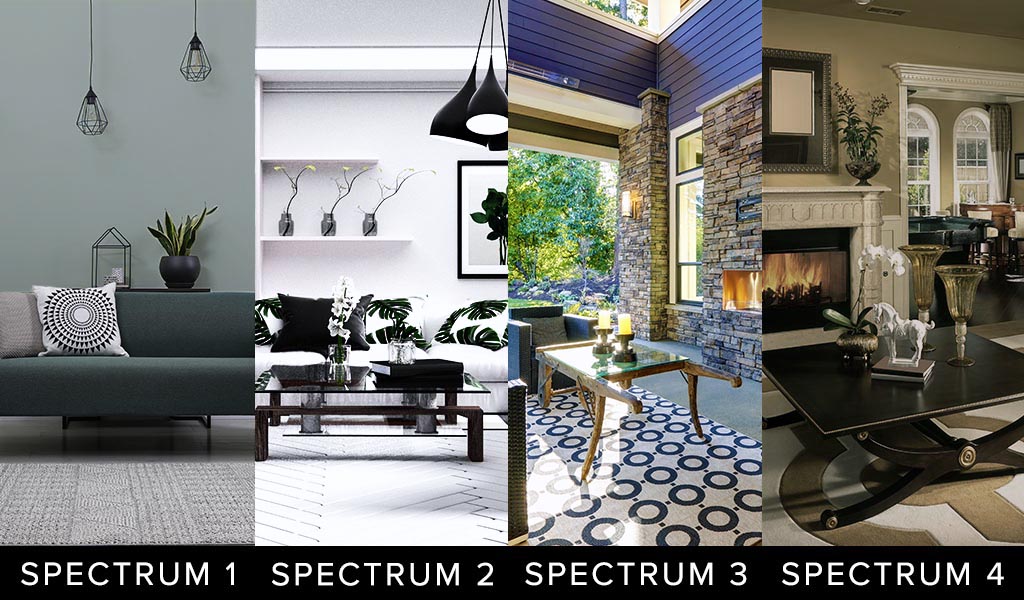
Notice the differences in the four C Color Spectrums:
- C Color Spectrum 1 Greens and Grays are Cool Blue Based, Less Saturated, Appear Rubbed with Ash
- C Color Spectrum 2 Whites and Blacks are Cool Blue Based, More Saturated
- C Color Spectrum 3 Blues, Ivories, and Grays are Yellow Based, Moderately Saturated
- C Color Spectrum 4 Tans and Browns are Warm Red Based, Less Saturated, Appear Rubbed with Earth
The key to the classification of all colors is the temperature, saturation, and predominant base of one of the primary colors of blue, yellow, or red.
Wearing and utilizing both light and strong pigments during summer months can be revitalizing, as those types of colors complement the ease of the long summer days and nights. The same is true to refresh your home décor for the season.
How can you substantiate the summer colors that are superlative for you?
"Build Your Optimal Colored Summer Wardrobe With C Color®"
Since there are over 16.7 million colors in the world, relying on conventional color advice to differentiate summer colors that complement you produces inconsistent and contradictory results.
While one source advises you to wear reds or yellows, another source may encourage you to wear greens or blues. Additionally, these approaches do not take into consideration that all colors are created with a temperature, saturation, and predominant base of one of the primary colors of either blue, yellow, or red.
The objective of C Color is to offer a unique and superior encounter with color.
Availing oneself of the C Color Methodology is the most accurate way to determine your unrivaled summer colors, due to the fact that the construct originates from the belief that there is a color gene within your DNA.
C Color Teaches You To Look Inside For Color

C Color can affirm the colors that you are inherently drawn toward, eliminating the need to abide by confusing color advice or follow general trends that you find unappealing.
Wearing and surrounding yourself with your favorable colors can enhance your appearance, can enable you to think more clearly, can produce feelings of well-being, can motivate you to act your best, can assist you in absorbing new concepts more readily and distinctly and can aid you in healing.
The benefits of color become apparent to people when they feel more confident, receive compliments, and notice that the optimal colors give their complexions a flawless and glowing appearance.
"How to Identify Your Summer Colors"
C Color® is the first and only company to quantify intuitive color preferences. Quantifying intuitive color partialities is the specialty of our lifestyle technology company.
The C Color Ideology is predicated upon a color gene within your DNA. You are born with immanent inclinations toward color; thereupon, you embody the virtue of color intelligence.
The C Color® Ideology and C Color® Methodology will support you in living life in your exemplary color environment, as C Color has deciphered the color code and provides you a cogent, compelling, and linear color tenet.
The millions of colors in the world have been classified into four C Color Spectrums. Each color is categorized by the temperature, saturation, and predominant base of one of the primary colors of either blue, yellow, or red.
All C Color Spectrums include virtually all colors, along with lighter and stronger pigmented hues.
Start by taking the C Color Quiz to ascertain your natural desire for color and your C Color Spectrum.
The objective of the C Color Quiz is to select the color quadrant that immediately catches your eye. In doing so, you are following your color proclivities; therefore, the accurate results of the C Color Quiz emanate from intuitive choices, not thought choices. Thinking about your color selections will skew your results.
Due to this reason, receiving a Personal C Color Analysis differs from all others on the market.
The efficacy of the C Color Quiz is 99.8%. We do not guarantee hundred percent efficacy, as clients may not consistently follow their innate preferences or intuition throughout the C Color Quiz.
Please be sure to visit the C Color Website.
The refreshed C Color Website includes a plethora of engaging content, simple navigability, and instructive visuals representative of each C Color Spectrum.
Browse the C Color Website and C Color Blog Posts for a colorful experience and inspiration regarding all things color.
Below are examples of how individuals from each of the four C Color Spectrums can wear pink, blue, and beige summer colors.
Please note that clothing and accessory colors are for reference only and do not represent the models' C Color Spectrums.
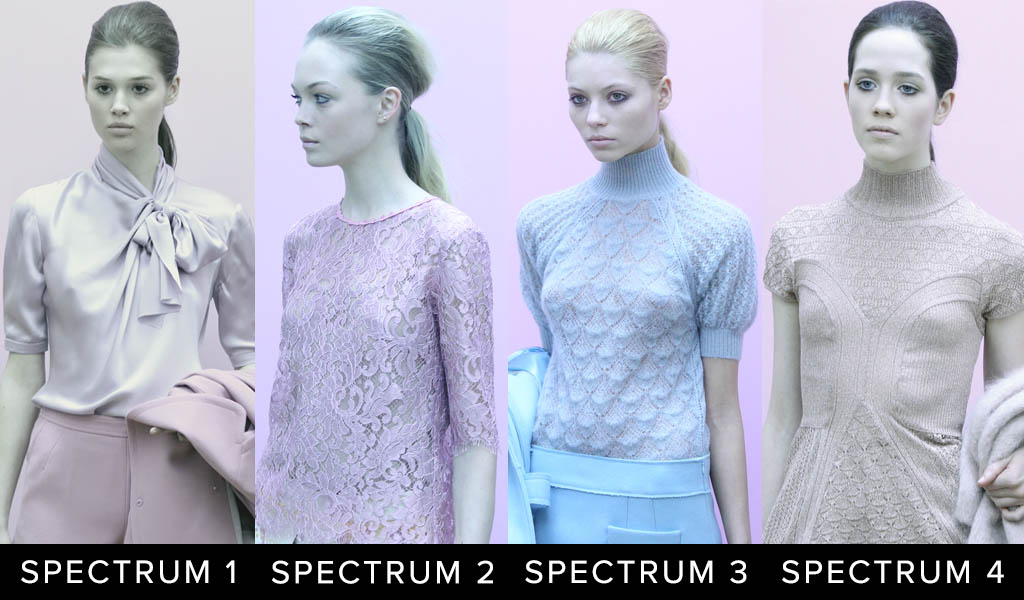
Notice the differences in the four C Color Spectrums:
- C Color Spectrum 1 Pink is Cool Blue Based, Less Saturated, Appears Rubbed with Ash
- C Color Spectrum 2 Pink is Cool Blue Based, More Saturated
- C Color Spectrum 3 Blue is Warm Yellow Based, Moderately Saturated
- C Color Spectrum 4 Beige is Warm Red Based, Less Saturated, Appears Rubbed with Earth
The key to the classification of all colors is the temperature, saturation, and predominant base of one of the primary colors of blue, yellow, or red.
When you choose and wear the colors from within your C Color Spectrum®, you are following an intrinsic trait, hence, your overall appearance is enhanced.
Below are examples of how individuals from each of the four C Color Spectrums can wear purple, blue, yellow, and green colors during the summer months.
Please note that clothing and accessory colors are for reference only and do not represent the models' C Color Spectrums.

Notice the differences in the four C Color Spectrums:
- C Color Spectrum 1 Purple is Cool Blue Based, Less Saturated, Appears Rubbed with Ash
- C Color Spectrum 2 Blue is Cool Blue Based, More Saturated
- C Color Spectrum 3 Yellow is Warm Yellow Based, Moderately Saturated
- C Color Spectrum 4 Green is Warm Red Based, Less Saturated, Appears Rubbed with Earth
The key to the classification of all colors is the temperature, saturation, and predominant base of one of the primary colors of blue, yellow, or red.
Look and feel prettier or more handsome; experience glowing skin; receive compliments; gain confidence; and garner color confidence.
While the C Color Ideology is established from scientific thought, the result of our color expertise is ultimately an outward expression of what is inside of all of us.
Ready to curate a wardrobe that gives your complexion a glowing and flawless appearance?
C Color Gets You There!
Remember: Hair, Eye, and Skin Colors Don't Matter
"Sunset is still my favorite color, and rainbow is second." ...Mattie Stepanek, Poet
Socialize With Us